|
| Willi Hennig four years before his death |
The
advent of cladistics has both blessed entomology with greater understanding of
the subjects it studies, and cursed it with taxonomic chaos; this is truer of
some insect taxa than others, and especially true of the order Diptera (flies):
none other than Willi Hennig (1913-1976)—he to blame for cladistics' creation—was first and foremost a
dipterist. Therefore, it is to be expected that our understanding of fly
phylogeny has been drastically affected in recent years by the innovations that
Hennig set in motion, no less than his personal revisions to higher-level
dipteran taxonomy.
Specifically,
the taxonomy of the lower Brachycera is now an exemplar of phylogenetic
instability. These flies were once classified as a taxon called Orthorrhapha,
but recognition that this group simply constituted all brachycerans that did not
belong in the Cyclorrhapha put an end to its usage by
dipterists; the orthorrhaphous superfamily Empidoidea is obviously sister to
the Cyclorrhapha*, and together they constitute the Eremoneura. Beyond that,
the phylogeny becomes (for lack of a better word) hairy: the Asiloidea may be
either eremoneurans' adelphotaxon, or they may be paraphyletic—with
the Bombyliidae and Mythicomyiidae their own clade (Bombylioidea), and/or with Apystomyia
elinguis (translating more or less to "the fly of which nothing is
known"; Marshall, 2012) constituting its own family and classified as the
Eremoneura's sibling (Wiegmann et al., 2011).
 |
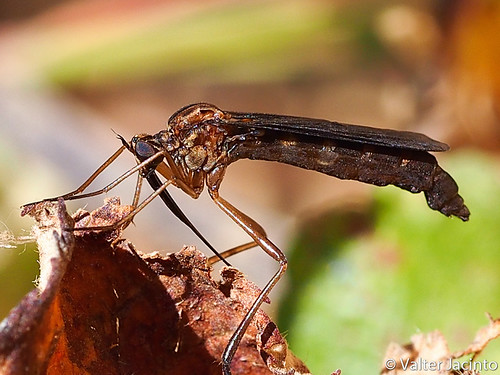
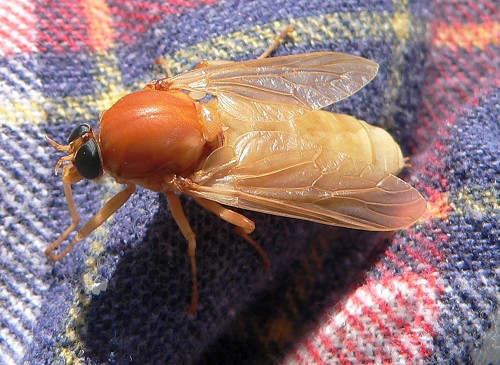
| An adult wormlion (probably Lampromyia sp.), photographed by Valter Jacinto |
The
remaining "Orthorrhapha" are no better understood: they consist of
two clearly monophyletic infraorders (Tabanomorpha and Stratiomyomorpha;
Woodley, 1989) plus an assortment of peculiar families whose phylogeny is up for
grabs. Among them, for instance, are the Vermileonidae (wormlions): their
maggots uniquely excavate pitfalls in friable substrates, catching prey a lá the notorious myrmeleontids, and are
distinctively specialized to that end (Ludwig et al., 2001); adults are
short-lived and feed on nectar (Devetak, 2008). Originally lumped in the
Rhagionidae (snipe flies), they were justifiably elevated to familial rank
(Nagatomi, 1977; Triplehorn and Johnson, 2005) and are now placed in their own
infraorder (Vermileonomorpha; Griffiths, 1994), which may either be closer to
the Asiloidea+Eremoneura clade or to the Tabanomorpha (possibly being even
included in the latter)—the evidence is inconclusive.
The
Nemestrinoidea, another group of lower Brachycera, are in a similar pickle.
This (putative) superfamily contains two most peculiar taxa (Woodley, 1989):
the Nemestrinidae and Acroceridae (formerly Cyrtidae). Their broader
relationships are debatable, as is their relation to each other (Woodley et
al., 2009): despite the many ecological parallels between the two,
which will now be detailed.
 |
| A Virginian Ogcodes borealis, noticed by Scott Justis |
The
Acroceridae will come first; after all, I
foreshadowed their appearance on this blog all the way back in January. Commonly known as
"small-headed flies" (for obvious reasons), they are rendered visually
distinctive by a bulky body (they were once dubbed "fat flies"—and
it's a pity that name didn't stick; Wiedemann, 1830), disproportionately small holoptic† head, and singularly
expansive calypters‡
(Schlinger, 1981): but
within the bounds of this physique, the small-headed flies vary in appearance;
there are circa 520 species described, and the family is fairly
cosmopolitan (Winterton & Gillung, 2012) and absent from oceanic islands, with New Caledonia and New Zealand having one precinctive genus each (Paramonov, 1955; Gillung & Winterton, 2011). Ecologically, all acrocerids with
habits known to science are larval parasitoids of spiders (Araneae), from which
their other colloquial address ("spider flies"; Schlinger et al.,
2013) is derived. There is an often-ignored report of Pterodontia flavipes larvae
being circumstantially found on mites (both in the cohort Parasitengona)
(Sferra, 1986), which may be corroborated by a similar association in Baltic
amber (Kerr & Winterton, 2008); but in both cases phoresy is no less likely
than parasitism.
 Additionally,
all acrocerid larvae seek out their hosts autonomously upon hatching (usually
nocturnally; Cole, 1919); the hyperactive first instar is termed a planidium:
the description and ontological purpose of which will be recalled by anyone who
is familiar with mantidflies (with which nemestrinoids converge markedly).
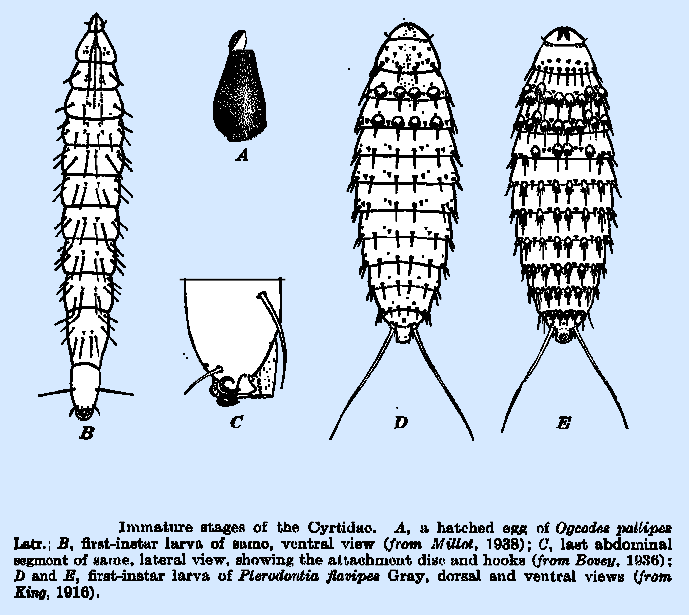
Rapid and broad dispersal is imperative; a number of acrocerid planidia bear a
posterior duo of elongated setae (as seen at left)—these facilitate leaping
(Cole, 1919; Bovey, 1936). Planidia of Acrocera, despite belonging to
the type genus of the family, deviate from the norm by affixing themselves to a
given substrate and awaiting some unfortunate spider's passage
(Schlinger, 2003).
Additionally,
all acrocerid larvae seek out their hosts autonomously upon hatching (usually
nocturnally; Cole, 1919); the hyperactive first instar is termed a planidium:
the description and ontological purpose of which will be recalled by anyone who
is familiar with mantidflies (with which nemestrinoids converge markedly).
Rapid and broad dispersal is imperative; a number of acrocerid planidia bear a
posterior duo of elongated setae (as seen at left)—these facilitate leaping
(Cole, 1919; Bovey, 1936). Planidia of Acrocera, despite belonging to
the type genus of the family, deviate from the norm by affixing themselves to a
given substrate and awaiting some unfortunate spider's passage
(Schlinger, 2003).
 |
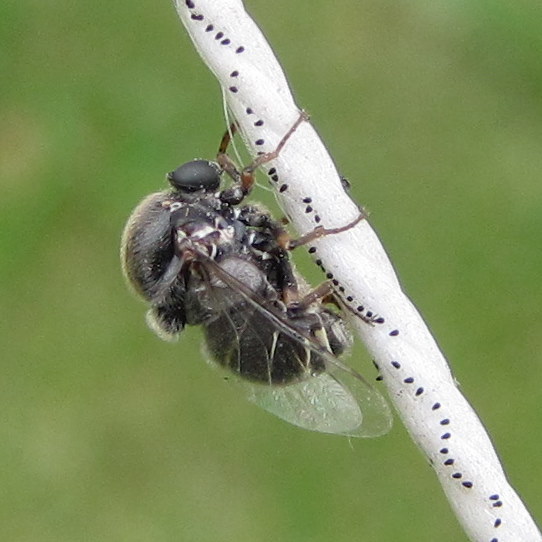
| A female Ogcodes eugonatus ovipositing on a clothesline; photographed by J. T. Layne in Missouri |
Those
of us remembering the likes of mantidflies and strepsipterans will know that another
trait in this suite of adaptive characteristics is a vast amount of offspring
per brood (compensating for the miniscule chance that any one planidium will
successfully locate a host): observations confirming this include that of a female
O. costatus, who was observed to lay 1,500 eggs within 2 hours;
and P. flavipes has been seen to oviposit at a rate of 51 eggs per
minute, and females of this species indeed strafe the leeward sides of
protrusive objects (e.g., fenceposts, twigs) with their eggs, which adhere
wherever they are fired due to their mucilaginous surfaces. Carpeting surfaces
with eggs is the preeminent strategy among acrocerid mothers (Clausen, 1940):
consequently, spiders that spend much of their time directly on substrates or
vegetation are disproportionately afflicted with small-headed flies in general
(Cady et al., 1993). (Small-headed flies are very catholic as far as
host preference at the generic level and above; Larrivée & Borkent,
2009.)
 |
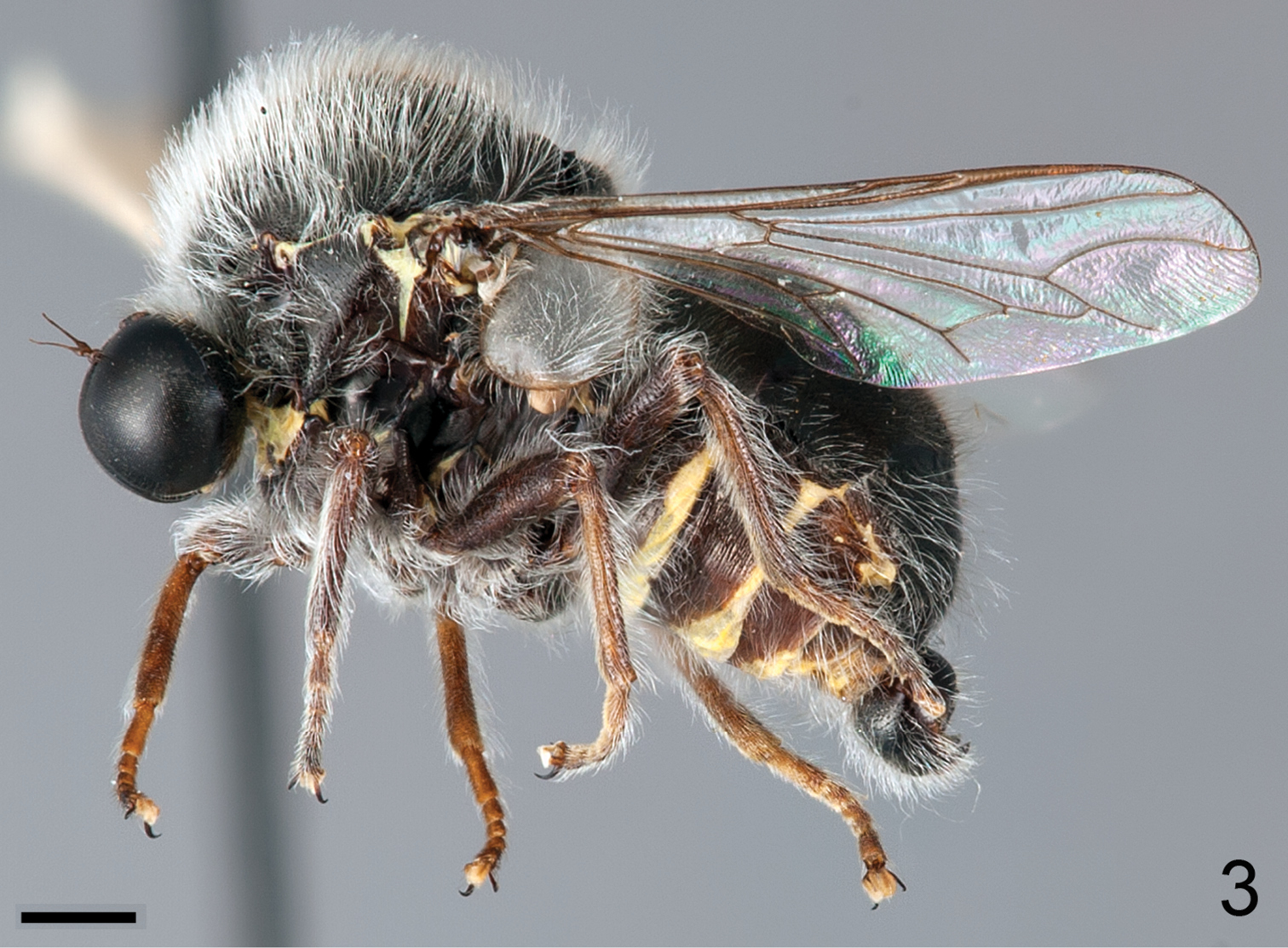
| A collected S. appendiculata, male, in lateral view |
Upon locating suitable
spiders, small-headed flies scurry up an available leg and manage an entry
through any membranous articulation they can find (King, 1916); A. orbicula firmly
seizes the host's exoskeleton with its mouthparts, then trepanning a miniscule
hole: moulting on the exterior, the larva makes an entry through the
previously-bored aperture rhizocephalan-style (Nielsen et
al., 1999). Both modes of penetration are universally followed by movement
to the host's abdomen. With the exception of Chile's Sphaerops appendiculata,
all small-headed flies with known habits are endoparasitoids—respiring
in the anaerobic environment of a spider's body by lodging their rearmost
spiracles in the host's book lungs (Schlinger, 1987). Prolonged diapause (with
a duration sometimes exceeding several years) may be entered depending on the
host's youth (or lack thereof), before essentially all its innards are devoured
in the maggot's fourth instar; prior to its demise, the said host often spins a
sheltering web for the benefit of its parasitoid's eventual pupation
(Montgomery, 1903).
 |
| Moegistorhynchus longirostris sipping from an iris (Lapeirousia anceps) (Zhang et al., 2012) |
As
adults, small-headed flies are often non-feeding; and their mouthparts are
naturally vestigial. The nectarivores among them are equipped with proboscides
of variable (but never-to-be-sneezed-at) length: as any ecologist would
suspect, a number of these are confirmed pollinating specialists (Borkent &
Schlinger, 2008)—but none have been ever more than implicated as primary pollinators
(Grant & Grant, 1965; Potgieter et al., 1999). Tangle-veined flies
(Nemestrinidae), on the other hand, mostly bear tremendously prolonged labia
(Teskey, 1981); and those living in southern Africa (especially within the Cape
Floristic Kingdom) comprise a keystone ecological guild as the sole pollinators
(along with some Tabanidae) of a goodly amount of long-tubed flowers across
four families (Pauw et al., 2009; Johnson, 2010). In fact, among them we
find Moegistorhynchus longirostris, a fly which has the honor of having
the most extreme proboscis-to-body ratio known among insects (4/1: Barraclough
& Slotow, 2010; Karolyi et al., 2012).
 |
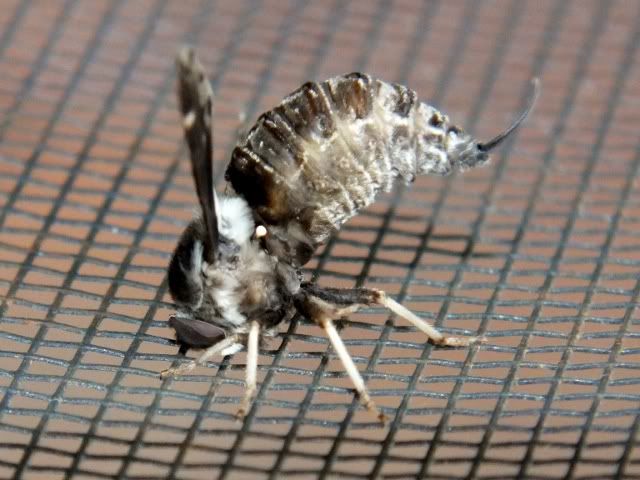
| Atriadops sp., female, on an Australian windowscreen; photographed by Alexander Pierce |
Living
nemestrinids (around 300 species; Evenhuis, 1994) constitute five subfamilies
(Atriadopsinae, Trichopsideinae, Nemestrininae, and the monogeneric
Hirmoneurinae and Cyclopsideinae); with little recent taxonomic modification
(Bernardi, 1973). Conversely, the subfamilial cladistics of the Acroceridae is
debated—traditionally
classified as the Philopotinae, Acrocerinae and Panopinae, with the latter
sister to the remainder (Schlinger, 1987); a more recent phylogeny rendered
"Acrocerinae" paraphyletic with respect to the philopotines, and
placed Sphaerops and Acrocera as a basal clade of small-headed
flies (Winterton et al., 2007).
 |
| Hirmoneura flavipes, caught in Arizona by Margarethe Brummermann |
Tangle-veined
flies are cosmopolitan hypermetamorphic parasitoids most diverse in subtropical arid regions (Narchuk, 2007), just as their spider-munching analogues; but subfamilies
differ in terms of host preferences: those Atriadopsinae whose habits are known
attack katydids (Tettigoniidae; Kanmyia, 1987), while the Hirmoneurinae are
parasitoids of something completely different—beetles of the family Scarabaeidae (Richter, 1997). Again, the first larval instar is planidial (Riley, 1883), although the precise procedure of host location is sketchy; females oviposit in crevices on bark-bared wood, laying batches of 100 eggs or so (Stuardo, 1935): H. exotica unaccountably deposit their eggs in the tunnels of wood-boring bees (Brauer, 1883). In any event, hirmoneurine larvae only feed during their hosts' pupal stage; upon the beetle's inevitable decease, they extrude themselves ventrally and pupate standing above the remnant of their meal, weirdly erect (Clausen, 1940).
Trichopsideines and nemestrinines plague grasshoppers (Acrididae) (Prescott, 1955) (the host[s]
of Cyclopsidea are so far undiscovered). Planidia penetrate the host's integument where it is softest, adjacent to the abdominal spiracles; after wandering the tracheae for a few days, they cut a different hole in the trachea (in Trichopsidea clausa; York & Prescott, 1952) or directly on the host's exoskeleton near a spiracle (in T. flavopilosa and the nemestrinine Neorhynchocephalus) and press their rearmost spiracles to the newly-made pore, subsequently burrowing deep into the grasshopper's entrails: and a ropy umbilicus then gradually forms from the host tissue, maintaining the larva's connection to the orifice it previously chewed, thereby permitting respiration. Nemestrinids sometimes take these respiratory tubes to proportions unseen among other parasitoids that utilize the same principle—in T. flavopilosa and costata (Potgieter, 1929), the final-instar larva's tube is twice its bodily length. If and when the host moults, the larva must create an entirely new pore, or else suffocate (Prescott, 1961).
 |
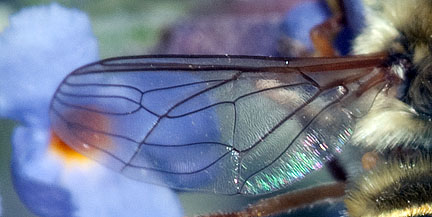
| Wing of Neorhynchocephalus sp., pictured by Robert Behrstock and exhibitng typically nemestrinid venation |
As their common name hints, tangle-veined flies' wing venation is unmistakably compressed, a fact made most obvious by the compound M4 oblique vein (Yeates, 1994; see left): this is an adaptation for nearly perpetual hovering (Grimaldi, 1999). Nemestrinids have a rich fossil record (largely in the form of their characteristic wings), extending as far back as the Early Jurassic (Ansorge & Mostovski, 2000); with an entire subfamily (Archinemestriinae) restricted to the Mesozoic (Mostovski, 1998): they become unusual after that geological era (Wedmann, 2007), but this is likely only due to a taphonomic bias against their preservation in amber; all Cenozoic species can be assigned to extant genera (Bequaert & Carpenter, 1936).
The fact that the earliest undoubted fossil of a small-headed fly only makes an appearance around 100 million years after the oldest known tangle-veined one (Mostovski, 1997; Grimaldi et al., 2002; Shi et al., 2012) could be a distinct strike against these insects' monophyly: chronological dissociation helped lead to the separation of the Mythicomyiidae from the Bombyliidae (Evenhuis, 2012). And thus are we led to the subject of nemestrinoid phylogeny. For many years, the Nemestrinoidea were regarded as closely akin to bee flies (Bombyliidae) merely by dint of the parasitoidal ontogeny they have in common (Hennig, 1973; Ovtshinnikova, 1998); but this treatment has been abandoned in favor of either situating the Nemestrinoidea near the Asiloidea (Woodley, 1989) or within the Tabanomorpha (Griffiths, 1994). Increasingly, Acroceridae and Nemestrinidae are phyletically dissociated, since they lack any unassailable synapomorphies (Woodley et al., 2009; Wiegmann et al., 2011).
 |
| A teneral stink fly (Coenomyia ferruginea) from Wisconsin, photographed by Marcie O'Connor |
A different possibility is suggested by study of the extinct family Rhagionemestriidae, which lived in Late Jurassic-Early Cretaceous Eurasia (Nel, 2010). Originally classified as aberrant tangle-veined flies (Ussatchov, 1968) before being elevated to the rank of family (Nagatomi & Yang, 1998), they remain indisputably nemestrinoid in affiliation. Their wing venation bears a number of remarkable similarities to that of the Xylophagidae (stink flies, etc.; placed alone in the infraorder Xylophagomorpha): the resemblance is so strong that the xylophagids Exeretoneura and Heterostomus have been classified by some as extant Rhagionemestriidae (Mostovski & Martínez-Delclòs, 2000), with the enigmatic latter genus being placed in the same subfamily as the peculiar rhagionemestriid Sinonemestrius (once ranked as a family; Nagatomi & Yang, 1998): but this is an untenable position, especially given that the pupa of Heterostomus has turned out to be most similar to those of the Pelecorhynchidae (a tabanomorph family) (Coscarón et al., 2013).
In any event, Sinonemestrius appears to provide us with a morphological link between the Xylophagidae and Nemestrinidae (Jarzembowski & Mostovski, 2000), at least. The Acroceridae, however, remain regrettably ambiguous.
Kudos to anyone who recognizes the literary reference made in this post's title...
*An unranked clade, sometimes synonymized with the infraorder Muscomorpha. More accurately, that infraorder refers to the Cyclorrhapha and the former Asilomorpha. In any event, cyclorrhaphous flies are united by the circularity of the opening they make in their puparium upon eclosion.
†Almost entirely consisting of eyes.
‡One of two basal lobes in a fly's wing, absent in a goodly number of species.
______________________________________________________________
Ansorge, J. and Mostovski, M. (2000). Redescription of Prohirmoneura jurassica Handlirsch, 1906 (Diptera, Nemestrinidae) from the Lower Tithonian lithographic limestone of Eichstätt (Bavaria). Neues Jahrbuch für Geologie und Paläontologie Monatshefte, 4, 235-243.
Bequaert, J. C. and Carpenter, F. M. (1936). The Nemestrinidae of the Miocene of Florissant, Colorado, and their relations to the recent fauna. Journal of Palaeontology, 10, 395-409.
Borkent,
C. J. and Schlinger, E. I. (2008). Pollen loads and pollen diversity on Eulonchus
tristis (Diptera: Acroceridae): implications for pollination and flower
visitation [electronic version]. The Canadian Entomologist, 140(2),
257-264. Retrieved 9/22/13 from http://journals.cambridge.org/action/displayAbstract?fromPage=online&aid=8484583
Barraclough,
D. and Slotow, R. (2010). The South African pollinator Moegistorhynchus
longirostris (Wiedemann, 1819) (Diptera: Nemestrinidae): notes on biology,
biogeography and proboscis length variation [electronic version]. African
Invertebrates, 51(2), 397-403. Retrieved 9/23/13 from http://www.researchgate.net/publication/232691797_The_South_African_Keystone_Pollinator_Moegistorhynchus_longirostris_%28Wiedemann_1819%29_%28Diptera_Nemestrinidae%29_Notes_on_Biology_Biogeography_and_Proboscis_Length_Variation
Bernardi,
N. (1973). The genera of the family Nemestrinidae (Diptera, Brachycera). Arquivos
de Zoologia, 24(4), 211-318.
Bovey,
P. (1936). Sur la ponte et la larvae primare d'Ogcodes
pallipes. Latreille Soc. Vaud. des Sci. Nat. Bul., 59, 171-176.
Brauer, F. (1883). Erganzende Bemerkungen zu a. Handlirsch's Mittheilungen über Hirmoneura obscura. Mg. Wien. Ent. Stg., 2, 25-26.
Cady, A.; Leech, R.; Sorkin, L.; Stratton, G.; and Caldwell, M.
(1993). Acrocerid (Insecta: Diptera) life histories, behaviors, host spiders
(Arachnida: Araneida), and distribution records. The Canadian Entomologist,
125, 931-944.
Clausen,
C. P. (1940). Entomophagous Insects. New York City: McGraw-Hill.
Cole,
F. R. (1919). The dipterous family Cyrtidae in North America. Transcriptions
of the American Entomological Society, 45, 1-69. Retrieved 9/14/13 from http://www.jstor.org/stable/pdfplus/25077002.pdf?acceptTC=true&
Coscarón, S.; Coscarón, M. C.; and Gil-Azevedo, L. H. (2013). On the enigmatic Heterostomus curvipalpis Bigot, 1857, with a description of the pupa (Diptera, Brachycera). Zootaxa, 3616(3), 268-276. Retrieved 9/30/13 from http://www.mapress.com/zootaxa/2013/f/z03616p276f.pdf
Devetak,
D. (2008). Wormlions Vermileo vermileo (L.) (Diptera: Vermileonidae) in
Slovenia and Croatia. Ann. Ser. Hist. Nat., 18(2), 283-286. Retrieved
9/2/13 from http://www.google.com/url?sa=t&rct=j&q=&esrc=s&source=web&cd=1&ved=0CDAQFjAA&url=http%3A%2F%2Fwww.dlib.si%2Fstream%2FURN%3ANBN%3ASI%3ADOC-HEQZ3FMC%2F574ad873-e8df-49f8-94e4-7c6da027d08b%2FPDF&ei=cBAlUtnjLsinsQTWsoCABQ&usg=AFQjCNE-8ef4xtP3jASFAkpQlIGhnPorkA&sig2=Avf9ZNXW2a5uDGLQ4m1mgw&bvm=bv.51495398,d.cWc
Evenhuis,
N. L. (1994). Catalogue of the Fossil Flies of the World (Insecta: Diptera).
Leiden: Backhuys.
Evenhuis, N. L. (2012). Family Mythicomyiidae. Catalog of the Diptera of the Australasian and Oceanian regions (online version). Retrieved 9/29/13 from http://hbs.bishopmuseum.org/aocat/aocathome.html
Gillung, J. P. and Winterton, S. L. (2011). New genera of philopotine spider flies (Diptera, Acroceridae) with a key to living and fossil genera. ZooKeys, 127(2011), 15-27. Retrieved 9/29/13 from http://www.pensoft.net/journals/zookeys/article/1824/abstract/new-genera-of-philopotine-spider-flies-diptera-acroceridae-with-a-key-to-living-and-fossil-genera
Grant,
V. and Grant, K. A. (1965). Flower Pollination in the Phlox Family. New
York City: Columbia University Press.
Griffiths,
G. C. D. (1994). Relationships among the major subgroups of Brachycera
(Diptera): a critical review. Canadian Entomology, 126, 861-880.
Grimaldi, D. A. (1999). The co-radiations of pollinating insects and angiosperms in the Cretaceous. Annals of the Missouri Botanical Garden, 86, 373-406.
Grimaldi, D. A.; Engel, M. S.; and Nascimbene, P. C. (2002). Fossiliferous Cretaceous amber from Myanmar (Burma): its rediscovery , biotic diversity, and paleontological significance. American Museum Novitates, 3361, 1-71.
Jarzembowski, E. A. and Mostovski, M. B. (2000). A new species of Sinonemestrius (Diptera: Brachycera) from the Weald Clay (Lower Cretaceous, southern England), with a discussion of its affinities and stratigraphical implications. Cretaceous Research, 21(2000), 761-765. Retrieved 9/30/13 from http://www.researchgate.net/publication/222656799_A_new_species_of_Sinonemestrius_%28Diptera_Brachycera%29_from_the_Weald_Clay_%28Lower_Cretaceous_southern_England%29_with_a_discussion_of_its_affinities_and_stratigraphical_implications?citationList=outgoing
Johnson,
S. D. (2010). The pollination niche and its role in the diversification and
maintenance of the southern African flora. Philosophical Transactions of the
Royal Society Series B, Biological Sciences; 365, 499-516.
Kanmyia,
K. (1987). New records of endoparasitic Nemestrinidae and Tachinidae (Diptera)
on Tettigoniidae. Acta Dipterologica, 15, 14.
Karolyi,
F.; Szucsich, N. U.; Colville, J. F.; and Krenn, H. W. (2012). Adaptations for
nectar-feeding in the mouthparts of long-proboscid flies. Biological Journal
of the Linnaean Society, 107, 414-424. Retrieved 9/23/13 from http://onlinelibrary.wiley.com/doi/10.1111/j.1095-8312.2012.01945.x/pdf
Kerr,
P. H. and Winterton, S. L. (2008). Do parasitic flies attack mites? Evidence in
Baltic amber [electronic version]. Biological Journal of the Linnaean
Society, 93(1), 9-13. Retrieved 9/16/13 from http://era.deedi.qld.gov.au/1203/
King,
J. L. (1916). Observations on the life history of Pterodontia flavipes Gray
[electronic version]. Annals of the Entomological Society of America, 9, 309-321.
Retrieved 9/18/13 from http://www.ingentaconnect.com/content/esa/aesa/1916/00000009/00000003/art00005
Larrivée, M. and Borkent, C. J. (2009).
New spider host associations for three acrocerid fly species [electronic
version]. Journal of Arachnology, 37(2), 241-242. Retrieved 9/26/13 from
http://www.bioone.org/doi/abs/10.1636/T08-62.1
Ludwig,
P.; Melzer, R. R.; and Ehrhardt, V. (2001). Larval morphology and
classification of wormlions (Diptera: Vermileonidae). Mitt. Dtsch. Ges.
Allg. Angew. Ent., 13, 89-94.
Marshall, S. (2012). Flies: the Natural History and Diversity of Diptera. Richmond Hill: Firefly Publishing.
Montgomery,
T. H. (1903). Studies on the habits of spiders, particularly those of the
mating period. Proceedings of the National Academy of Sciences of
Philadelphia, 65, 58-149.
Mostovski, M. B. (1997). To the knowledge of fossil dipterans of superfamily Archisargoidea (Diptera, Brachycera). Palaeontological Journal, 1, 72-77.
Mostovski, M. B. (1998). A revision of the Nemestrinid flies (Diptera, Nemestrinidae) described by Rohdendorf, and a description of new taxa of the Nemestrinidae from the Upper Jurassic of Kazakhstan. Palaeontological Journal, 32, 369-375.
Mostovski, M.B. and Martínez-Delclòs, X. (2000). New Nemestrinoidea (Diptera: Brachycera) from the Upper Jurassic-Lower Cretaceous of Eurasia, taxonomy and paleontology [electronic version]. Entomological Problems, 31(2), 137-148. Retrieved 9/30/13 from http://fossilinsects.net/pdfs/Most_Delclos_2000LR.pdf
Nagatomi,
A. (1977). Classification of lower Brachycera (Diptera). Journal of Natural
History, 11, 321-335.
Nagatomi, A. (1992). Notes on the phylogeny of various taxa of the orthrrhaphous Brachycera (Insecta: Diptera). Zoological Sciences, 9, 843-857.
Nagatomi, A. and Yang, D. (1998). A review of extinct Mesozoic genera and families of Brachycera (Insecta, Diptera, Orthorrhapha). Entomologist's Monthly Magazine, 134, 95-192.
Narchuk, E. P. (2007). Nemestrinid flies (Diptera, Nemestrinidae) in the fauna of Eastern Europe and the Caucasus [electronic version]. Retrieved 9/29/13 from http://download.springer.com/static/pdf/15/art%253A10.1134%252FS0013873807080143.pdf?auth66=1380654571_05e4f8df1ad77ac2fdac6f7dd646fec0&ext=.pdf
Nel, A. (2010). A new Mesozoic-aged rhagionemestriid fly (Diptera: Nemestrinoidea) from China. Zootaxa, 2645, 49-54. Retrieved 9/30/12 from http://mapress.com/zootaxa/2010/f/z02645p054f.pdf
Nielsen,
B. O.; Funch, P.; and Toft, S. (1999). Self-injection of a dipteran parasitoid
into a spider. Naturwissenschaften, 86(11), 530-532. Retrieved 9/12/13
from http://www.ncbi.nlm.nih.gov/pubmed/10551947
Ovtshinnikova, O. G. (1998). A brief review of male genital musculatures in Brachycera Orthorrhapha (Insecta, Diptera) with special reference to phylogenetic relationships of families. Proceedings of the Zoological Institute of RAS, 276, 143-147.
Paramonov, S. J. (1955). New Zealand Cyrtidae (Diptera) and the problem of the Pacific island fauna. Pacific Science, 9, 16-25.
Pauw,
A.; Stofberg, J.; and Waterman, R. J. (2009). Flies and flowers in Darwin's
race. Evolution, 63, 268-279.
Potgieter, J. T. (1929). A contribution to the biology of the brown swarm locust Locusta pardalina (Wlk.) and its natural enemies. Pan-African Agricultural and Veterinary Conference, Pretoria; Proceedings of the Agricultural Section, 265-238.
Potgieter, C. J.; Edwards, T. J.; Miller, R. M.; and van Staden, J. (1999).
Pollination of seven Plectranthus spp. (Lamiaceae) in southern Natal,
South Africa. Plant Systematics and Evolution, 218, 99-112.
Prescott, H. W. (1955). Neorhynchocephalus sackenii and Trichopsidea clausa: nemestrinid parasites of grasshoppers [electronic version]. Annals of the Entomological Society of America, 48(5), 392-402. Retrieved 9/28/13 from http://www.m3cg.us/hopper/content/neorhynchocephalus-sackenii-and-trichopsidea-clausa-nemestrinid-parasites-grasshoppers
Prescott, H. W. (1961). Respiratory pore construction in the host by the Nemestrinid parasite Neorhynchocephalus sackenii (Diptera), with notes on respiratory tube characters. Annals of the Entomological Society of America, 54(4), 557-566. Retrieved 9/29/13 from http://www.ingentaconnect.com/content/esa/aesa/1961/00000054/00000004/art00021?crawler=true
Richter, V. A. (1997). Family Nemestrinidae. In Papp, L. and Darvas, B. (eds.) (pp. 459-468): Contributions to a Manual of Palaearctic Diptera, vol. 2. Budapest: Science Herald.
Riley, C. V. (1883). Larval stages and habits of the bee-fly Hirmoneura. Science, 1, 332-334.
Schlinger,
E. I. (1981). Acroceridae. In McAlpine, J. F.; Peterson, B. V.; Shewell, G. E.;
Teskey, H. J.; Vockeroth, J. R.; and Wood, D. E. M. (eds.) (pp. 575-584): Manual
of Nearctic Diptera, vol. 1. Agriculture Canada: Research Branch.
Schlinger,
E. I. (1987). The biology of Acroceridae (Diptera): true endoparasitoids of
spiders. In Nentwig, W. (ed.) (pp. 319-327): Ecophysiology of Spiders. Berlin:
Springer Verlag.
Schlinger,
E. I. (2003). Acroceridae, spider-fly endoparasitoids. In S. M. Goodman and J.
P. Bernstead (eds.) (pp. 734-740): The Natural History of Madagascar. Chicago:
University of Chicago Press.
Sferra,
N. J. (1986). 1st record of Pterodontia flavipes (Diptera, Acroceridae)
larvae in the mites Podothrombium (Acari, Trombidiidae) and Abrolophus
(Acari, Erythraeidae) [electronic version]. Entomological News, 97, 121-123.
Retrieved 9/16/13 from http://biostor.org/reference/77015
Shi, G.; Grimaldi, D. A.; Harlow, G. E.; Wang, J.; Wang, J.; Yang, M.; Lei, W.; Li, Q.; and Li, X. (2012). Age constraint on Burmese amber based on U-Pb dating of zircons. Cretaceous Research, 37(2012), 155-163. Retrieved 9/29/13 from http://www.sciencedirect.com/science/article/pii/S0195667112000535?np=y
Stuardo, C. (1935). Algunas observaciones sobre las costumbres y metamorfosis de Hirmoneura articulata. Ph. Rev. Chilena de Hist. Nat., 1934, 197-202.
Triplehorn,
C. A. and Johnson, N. F. (2005). Borror and DeLong's Introduction to the
Study of Insects (7th ed.). Belmont: Thomson Brooks/Cole.
Ussatchov, D. A. (1968). New Jurassic Asilomorpha (Diptera) of the fauna of Karatau. Entomological Review, 47(3), 617-628.
Wedmann, S. (2007). A nemestrinid fly (Insecta: Diptera: Nemestrinidae: cf. Hirmoneura) from the Eocene Messel Pit (Germany) [electronic version]. Journal of Paleontology, 81(5), 1,114-1,117. Retrieved 9/29/13 from http://www.jstor.org/stable/4498863?seq=3
Wiedemann,
C. R. W. (1830). Familie der Feistfliegen (Inflatae). Aussereuropaische
Zweiflügelege Insekten, 2, 13-20.
Wiegmann,
B. M.; Trautwein, M. D.; Winkler, I. S.; Barr, N. B.; Kim, J.; Lambkin, C.;
Bertone, M. A.; Cassel, B. K.; Bayless, K. M.; Heimberg, A. M.; Wheeler, B. M.;
Peterson, K. J.; Pape, T.; Sinclair, B. J.; Skevington, J. S.; Blagoderov, V.;
Caravas, J; Kutty, S. N.; Schmidt-Ott, U.; Kampmeier, G. E.; Thompson, F. C.;
Grimaldi, D. A.; Beckenbach, A. T.; Courtney, G. W.; Friedrich, M.; Meier, R.;
and Yeates, D. K. (2011). Episodic radiations in the fly tree of life. Proceedings
of the National Academy of Sciences, United States; 108.
Winterton,
S. L.; Wiegmann, B. M.; and Schlinger, E. I. (2007). Phylogeny and Bayesian
divergence time estimations of small-headed flies (Diptera: Acroceridae) using
multiple molecular markers [electronic version]. Molecular Phylogenetics
& Evolution, 43(3), 808-832. Retrieved 9/27/13 from http://www.sciencedirect.com/science/article/pii/S105579030600323X
Woodley,
N. E. (1989). Phylogeny and classification of the "Orthorrhaphous"
Brachycera. In McAlpine, J. F. (ed.) (pp. 1371-1395): Manual of Nearctic
Diptera, vol. 3. Agriculture Canada: Research Branch.
Woodley,
N. E.; Borkent, A.; and Wheeler, T. A. (2009). Phylogeny of the Diptera. In
Brown, B. V.; Borkent, A.; Cumming, J. M.; Wood, D. M.; Woodley, N. E.;
Zumbado, M. A. (eds.) (pp. 9-50): Manual of Central American Diptera, vol. 1.
Ottawa: NRC Research Press.
Yeates,
D. K. (1994). The cladistics and classification of Bombyliidae (Diptera:
Asiloidea) [electronic version]. Bulletin of the American Museum of Natural
History, 219, 1-191. Retrieved 9/24/13 from http://digitallibrary.amnh.org/dspace/handle/2246/826
York, G. T. and Prescott, H. W. (1952). Nemestrinid parasites of grasshoppers. Journal of Economic Entomology, 45, 5-10.
Zhang,
F.; Hui, C.; and Pauw, A. (2012). Adaptive divergence in Darwin's race: how
coevolution can generate trait diversity in a pollination system [electronic
version]. Evolution, 67(2), 548-560. Retrieved 9/22/13 from http://onlinelibrary.wiley.com/doi/10.1111/j.1558-5646.2012.01796.x/pdf