Thursday, May 8, 2014

Glimpsing Armadillo Ants

File:The Ants (Wilson Hölldobler book).jpg
One of the favorite books of my formative years (and also the favorite, I am sure, of a few others) was Bert Hölldobler and Edward O. Wilson's tome The Ants: a synthesis of the sum total of myrmecological knowledge up to 1990, and winner of the 1991 Pulitzer Prize in non-fiction (perhaps the only straight-up textbook to have ever done so; Yee, 2004). As an incipient preadolescent entomologist, my favorite part of the book's contents was the section devoted to collated line drawings and profiles of all ant genera considered valid at the time (organized by subfamily).

Peruvian worker of T. tatusia; photograph by Erin Prado
By poring over these figures time and time again, I was gradually familiarized with the distinctive silhouettes of many an ant, solidifying the more morphologically peculiar ones in my memory (the adorably wacky Discothyrea comes to mind here). Among these more striking sketches was one detailing the morphology of a species by the name of Tatuidris tatusia, contained in the Myrmicinae: in my usual learning process, I looked the name up in the index to find if any data were contained elsewhere in the book on the taxon. But The Ants would yield no information on T. tatusia, other than that it was the sole extant member of the myrmicine (Carpenter, 1930) tribe Agroecomyrmecini. It made perfect sense to me that Tatuidris (the etymology of the name suggested the ant's epithet "armadillo"; Lacau et al., 2012) should have a tribe all to itself—what with its generally weird habitus (a combination of a prominent stinger, clubbed antennae, and distinctively heart-shaped face); but this strangeness further made me wonder whether it was genuinely myrmicine in identity (doubts that were incidentally shared by some taxonomists, as we shall see).

Aside from Tatuidris, the armadillo ants include only the extinct genera Agroecomyrmex (from Baltic amber; Wheeler, 1914) and Eulithomyrmex (from the Coloradoan Florissant Formation; Carpenter, 1935): both date to the Paleogene Period (the latter about 10 million years younger than the former; Ritzkowski, 1997; Foos & Hannibal, 1999). Their assignment to the Myrmicinae (one of the most speciose single subfamilies within the Formicidae) was made on the basis of morphological similarities to members of the tribe Phalacromyrmecini, and, to a lesser extent, Dacetini (Brown & Kempf, 1968; Brown, 1977; Bolton, 1984): these common characteristics include an expanded facial vertex and deepened scrobes* (the extension of which all the way back to the eyes is another distinctive quality of Tatuidris; Baroni Urbani & de Andrade, 2007). Right from the description of the first living agroecomyrmecine (T. tatusia) these traits were suspected of being only dubiously indicative of kinship (Brown & Kempf, 1968; Bolton, 1984): speciousness affirmed by the elevation of the Agroecomyrmecini to subfamily rank (Bolton, 2003), although the first fully cladistic analysis of T. tatusia affirmed its relation to the Dacetini and inclusion within the Myrmicinae (Baroni Urbani & de Andrade, 2007). 

Ecuadorian bullet ant (Paraponera clavata) photographed by Alex Wild (who else?)
Classifying armadillo ants within their own subfamily—as is the prevalent opinion at the moment—still begs an answer to their true phylogeny. Two opposing theories seem to have arisen on the matter of agroecomyrmecine placement within the Formicidae: one regards the subfamily as sister-group of the Myrmicinae (Bolton, 2003); the other, as within the grab-bag of "poneromorph" subfamilies (the Amblyoponinae, Ectatomminae, Heteroponerinae, Paraponerinae, Proceratiinae, and Ponerinae) which sit at the base of the "formicoid" clade in which the Myrmicinae is placed (Ward, 2009): specifically, close to the monotypic Paraponerinae (Brady et al., 2006) or near the Amblyoponinae (Rabeling et al., 2008). The results of one mainly morphological study resolve the ambiguity by deriving the Myrmicinae as both within the "poneroids" (Keller, 2011) and akin to the armadillo ants. 

Variation in pilosity patterns within T. tatusia (Donoso, 2012)
With all of this ambiguity, one can only wonder if biological data on the only extant armadillo ant would be at all informative in agroecomyrmecine phylogeny. T. tatusia has been collected throughout southern Mesoamerica and northern South America, reaching greatest abundance in upland areas (largely between 800 and 1,200 meters in altitude); the species includes multiple morphs throughout its range (which on one occasion caused the mistaken description of new species; Lacau et al., 2012) and exhibits  an unusual degree of intraspecific genetic variation: this suggests either that the population in fact consists of several cryptic species that taxonomists do not yet have the information to confidently delineate, or that it is a lineage in the process of allopatric speciation (Donoso, 2012).

Almost nothing is known of the habits of T. tatusia, given that until recently none had been observed in life: but its weirdly elongated stinger and thickly interlocking setae on the inner margins of the mandibles—not to mention intramandibular glands clustered in a manner unknown in other ants (Billen & Delsinne, 2013)—have encouraged speculation on the ant's presumably unorthodox biology. In further tantalization, the discovery of the first live colony (containing erstwhile-unknown drones and queens) revealed only that armadillo ants have a diet that does not include the following likely items:

" ... live and dead termites, millipedes, mites, various insect parts, sugar water, tuna, biscuits, live and dead fruit flies (Drosophila), live springtails, live myriapods (Chilopoda and Diplopoda) [centipedes and millipedes], live and dead Diplura, small live spiders, small live pseudoscorpions, one small snail, uncooked hen egg ... ant larvae (Gnamptogenys sp.), and live ant workers (Cyphomyrmex sp., Brachymyrmex sp.)." (Donoso, 2012)
Hence, we can only assume that T. tatudris is a most specialized predator. Of what, precisely, remains to be seen whenever science captures its next glimpse of armadillo ants. 
                           

*Cephalic slots into which antennae can be retracted.
______________________________________________________________

Baroni Urbani, C. and de Andrade, M. L. (2007). The ant tribe Dacetini: limits and constituent genera, with descriptions of new species. Annali del Museo Civico di Storia Naturale "G. Doria", 99, 1-191.

Billen, J. and Delsinne, T. (2013). A novel intramandibular gland in the ant Tatuidris tatusia (Hymenoptera: Formicidae). Myrmecological News, 19, 61-64. Retrieved 5/8/14 from http://bio.kuleuven.be/ento/pdfs/billen_delsinne_myrmnews_2013.pdf

Bolton, B. (1984). Diagnosis and relationships of the myrmicine ant Ishakidris gen. n. (Hymenoptera: Formicidae). Systematic Entomology, 9, 373-382.

Bolton, B. (2003). Synopsis and classification of Formicidae. Memoirs of the American Entomological Institute, 71, 1-370.

Brady, S. G.; Schultz, T. R.; Fisher, B. L.; and Ward, P. S. (2006). Evaluating alternative hypotheses for the early evolution and diversification of ants. Proceedings of the National Academy of Sciences of the United States of America, 103(48), 18172–18177.

Brown, W. L. (1977). An aberrant new genus of myrmicine ant from Madagascar. Psyche, 84, 218-224.

Brown, W. L. and Kempf, W. W. (1968). Tatuidris, a remarkable new genus of Formicidae (Hymenoptera). Psyche, 74, 183-190.


Carpenter, F. M. (1930). The fossil ants of North America [electronic version]. Bulletin of the Museum of Comparative Zoology, 70(1), 1-66. Retrieved 5/7/14 from http://gap.entclub.org/taxonomists/Carpenter/1930.pdf

Carpenter, F. M. (1935). A new name for Lithomyrmex Carp. (Hymenoptera) [electronic version]. Psyche, 42(2), 91. Retrieved 5/6/14 from http://www.hindawi.com/journals/psyche/1935/068604/abs/   

Donoso, D. A. (2012). Additions to the taxonomy of the armadillo ants (Hymenoptera, Formcidae, Tatuidris) [electronic version]. Zootaxa, 3503, 61-81. Retrieved 5/8/14 from http://mapress.com/zootaxa/2012/f/zt03503p081.pdf 

Foos, A. and Hannibal, J. (1999). Geology of Florissant Fossil Beds National Monument. Retrieved 5/5/14 from http://www2.nature.nps.gov/geology/education/foos/flfo.pdf    

Hölldobler, B. and Wilson, E. O. (1990). The Ants. The Belknap University Press of Harvard University Press: Cambridge.

Lacau, S.; Groc, S.; Dejean, A.; de Oliveira, M. L.; and Delabie, J. H. C. (2012). Tatuidris kapasi sp. nov.: a new armadillo ant from French Guiana (Formicidae: Agroecomyrmecinae). Psyche, 2012(2012), 926089, 1-7. Retrieved 5/8/13 from http://www.hindawi.com/journals/psyche/2012/926089/ 

Rabeling, C.; Brown, J. M.; and Verhaagh, M. (2008). Newly discovered sister lineage sheds light on early ant evolution. Proceedings of the National Academy of Sciences, USA; 105, 14913-14917.

Ritzkowski, S. (1997). K-Ar-Altersbestimmungen der bernsteinführenden Sedimente des Samlandes (Paläogen, Bezirk Kaliningrad). Metalla, Bochum; 66, 19-23.

Ward, P. S. (2009). Phylogeny, classification, and species-level taxonomy of ants (Hymenoptera: Formicidae) [electronic version]. Zootaxa, 1669, 549-563. Retrieved 5/8/14 from http://wardlab.files.wordpress.com/2012/01/ward_2007c_zoootaxa.pdf 

Wheeler, W. M. (1914). The ants of the Baltic amber. Schriften der Physikalisch-Okonomischen Gesellschaft, 55(4), 56-59.

Yee, D. (2004). The Ants: Bert Hölldobler + Edward O. Wilson. Retrieved 5/7/14 from http://dannyreviews.com/h/Ants.html     

Sunday, April 13, 2014

A Dragon Mite for the Buckeyes

Although a student of the Ohio State University, I have comparatively little "Buckeye spirit". I came here due to the excellence of the entomology department—not out of any sense of protean loyalty to the institution (not having grown up in Ohio), or particular hostility towards that University Up North (which I also considered for my undergraduate career). 

I did feel a surge of pride and excitement, however, upon hearing of the discovery of a new genus and species of mite (Osperalycus tenerphagus) right here on Main Campus: considering that this is only the second member of its family to be found on the North American continent, the discovery by graduate student Samuel Bolton (who works across the hall from my admittedly unassuming job in the Triplehorn Insect Collection) is an occurrence worthy of attention.

LT-SEM photograph of protonymph (above) and tritonymph (below) of Osperalycus tenerphagus (USDA)
O. tenerphagus is mainly noteworthy in terms of its membership in the family Nematalycidae: a taxon consisting of five monotypic genera (including Osperalycus), all known from fine sand in Africa, Eurasia, the Americas, Australia, and New Caledonia. They are easily distinguished by the wide separation of leg pairs I-II and III-IV, genitalia much closer to the hindmost pair of legs than to the body's posterior, and (most prominently) a ridiculously elongated body (see above). Due to their resemblance to the Chinese lung, the Nematalycidae have been called "dragon mites" (Bolton, 2014). In an interesting side note, all nematalycids appear to be parthenogenic (Bolton et al., 2014). 

LT-SEM photograph of O. tenerphagus when contracted (right) and at rest (left) (also USDA)
This draconine prolongation is associated with accordion-style bodily locomotion (in a word: inching), much like that seen in organisms as unrelated (and vastly larger) as earthworms and caecilians. It is facilitated by the heavily contractile and flexible integument of these mites (see right), which is enervated by longitudinal muscles running the length of the nematalycid body (all 600 micrometers of Ohio's only species; Wheeler, 2014). As a whole, this is an adaptation for a life in the interstices of sand particles.

Which is why where O. tenerphagus (the "Buckeye dragon mite") was discovered makes it special: not in an arenaceous environment like the rest of its kin, but in a surprisingly clayey soil ("Worm-like mite species found"—ScienceDaily). The presence of rutella in the Buckeye dragon mite's mouthparts is also significant in clearing up questions of phylogeny: it confirms that nematalycids belong in the Endeostigmata (a probably paraphyletic taxon) as opposed to the Trombidiformes (Bolton et al., 2014). 

But to me, the location will always be the kicker: you see, I've obliviously walked over the ground where Samuel Bolton found the creature at least four times a week since September. One never knows what can be found beneath one's feet...

Go Bucks!

____________________________________________________________

Bolton, S. J. (2014, February 20). New Species of Bizarre, Worm-like Mite Discovered on Ohio State University Campus. Entomology Today. Retrieved 4/13/14 from http://entomologytoday.org/2014/02/20/new-species-of-bizarre-worm-like-mite-discovered-on-ohio-state-university-campus/

Bolton, S. J.; Klompen, H.; Bauchan, G. R. and Ochoa, R. (2014). A new genus and species of Nematalycidae (Acari: Endeostigmata). Journal of Natural History. Retrieved 4/13/14 from http://www.tandfonline.com/doi/pdf/10.1080/00222933.2013.859318      

Wheeler, Q. (March 1, 2014). New to nature No 119: Osperalycus tenerphagus. The Observer. Retrieved 4/13/14 from http://www.theguardian.com/science/2014/mar/02/new-to-nature-osperalycus-tenerphagus  

Worm-like mite species discovered: A species from this 'extremophile' family hasn't been described for 40 years. (February 28, 2014). Retrieved 4/13/14 fromhttp://www.sciencedaily.com/releases/2014/02/140228155800.htm 

Thursday, February 20, 2014

The Origin of Earwigs

Cerci of Opisthocosmia cervipyga (Forficulidae: Opisthocosmiinae); photographed by Fabian Haas (©BMNH)
The name "earwig" is undoubtedly one of the least explicable colloquial names for an insect, rivaling "snake doctor" in the magnitude of its inaccuracy. (This term is a descriptor for dragonflies in the Deep South, referring to the folk tradition that they somehow stitch up wounded snakes; Hand, 1976). The name apparently originates from an old myth that these unobtrusive creatures nest in the ears of sleeping humans, a behavior that inevitably goes along in the popular imagination with habitual brain-eating. This belief is of course false; earwigs are no more likely to invade one's ears than any other insect with a desire to hide in dark, humid crannies. Which is admittedly meager comfort to any entomophobes who may be out there.

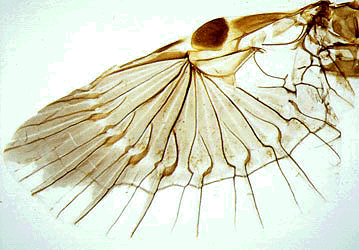
Outstretched hind wing of Allodahlia scabriscula (Forficulidae)
But what is an earwig in a taxonomic sense? A member of the Dermaptera (no, not Dermoptera*): a cosmopolitan order of medium size (1,784 extant spp. in 11 families; Sakai, 1982). They are dorsoventrally flattened, with an elongate abdomen capable of some muscular telescoping. Morphologically, earwigs' most distinctive traits are a lack of ocelli†, unsegmented pinching cerci (almost antler-like in the Opisthocosmiinae), forewings sclerotized into tegmina, and semicircular hindwings which unfold fan-style (see right) (in the case of those with wings; Haas et al., 2000). 

Hemimerus vosseleri (female)
But most of these these traits apply only to the members of the traditional suborder Forficulina, which constitute the majority of the global earwig fauna: those earwigs belonging to the suborders Arixeniina and Hemimerina are wingless and bear segmented cerci. Both are restricted to lone families: the latter (Hemimeridae) solely inhabit the fur of pouched rats (Nesomyidae: Cricetomyinae) in sub-Saharan Africa (Rehn & Rehn, 1935), grazing on the many varieties of their hosts' cutaneous grunge; their broad bodies, shortened retractable legs and smallish size (5-15 mm. long) make them unmistakable (Nakata & Maa, 1974). Indeed, so unlike most earwigs were they that Hemimerus was initially described as a cricket (Walker, 1871) and later allied with the ectoparasitic beetle Platypsyllus castoris (Sharp, 1892). It can be said that the initial entomological reaction to the Hemimeridae could be summed up in three letters: W, T and F (in that order).

Arixenia esau (female)
The former family (Arixeniidae) have a similar diet, but live on Malayan and Filipino bats of the genus Cheiromeles (Molossidae); these earwigs are more free-living than their rat-dwelling counterparts, being also found in their hosts' roosting areas (Medway, 1958). Arixeniids are significantly larger than hemimerids (25 mm.), with far shorter cerci, and conform to the weirdly long-legged habitus of many commensal insect inhabitants of bat fur (Nakata & Maa, 1974). 

Both of these families have adapted to an epizoic lifestyle by developing live birth (vivipary)—with embryos each developing at the termini of ovarian follicles, nourished by a thickened epithelium dubbed a "pseudoplacenta" (Hagan, 1951). Gestation in Arixenia esau is additionally complicated by the movement of older fetuses into their mother's oviduct, which is modified into an ad hoc uterus (Tworzydlo et al., 2013). It probably goes without saying that other earwigs conventionally lay eggs, except for the unexplained aberration that is Chaetospania borneensis (Spongiphoridae) (Kočárek, 2009).

Earwig, Apachyus spp.
An Apachyus sp. (Apachyidae); purportedly one of the closest relatives of the Hemimeridae (Engel & Haas, 2007)
Due to these considerable subordinal differences, the Dermaptera has on occasion been restricted to the Forficulina (Steinmann, 1986) or to that suborder and either the Hemimerina (Giles, 1963; Popham, 1985) or Arixeniina (Popham, 1961; Giles, 1974); indeed, the only robust trait uniting all earwigs as distinct from other "orthopteroids" is invisible to the naked eye: holocentric chromosomes (Rentz & Kevan, 1991). It has become increasingly clear that the epizoic families of earwigs must derive from within the Forficulina (Haas & Klass, 2003; Jarvis et al., 2005; Kočárek et al., 2013), although their precise phylogenies are still debated (Engel & Haas, 2007; Kočárek et al., 2013). Regardless, the trinity of Hemimerina, Arixeniina, and Forficulina are justifiably sunk into a single suborder termed Neodermaptera (Engel, 2003): a particularly sensible classification when one considers them in opposition to the extinct lineages of earwig.

Hence, for further illumination of earwig evolution we must draw on data derived from the field of paleontology, despite the fact that the dermapteran fossil record is far from copious (Wappler et al., 2005). Nevertheless, it includes not only representatives of the extant superfamilies Pygidicranoidea—putatively dating as far back as the late Jurassic (Shcherbakov, 2002) or no later than the mid-Cretaceous (Engel & Grimaldi, 2004)—and Forficuloidea (Wappler et al., 2005), as well as members of the similarly living families Labiduridae (Zhao et al., 2010) and Diplatyidae (Engel, 2011); but also two wholly prehistoric suborders: the Archidermaptera (Jurassic of Eurasia; Whalley, 1985) and Eodermaptera (later Jurassic of Kazakhstan and Manchuria, perhaps extending to as late as the Cretaceous; Zhang, 1994; Zhao et al., 2010). 

The latter suborder is evidently akin to the Neodermaptera, as deduced from their shared lack of annulation in the cerci (Haas & Kukalová-Peck, 2001) and 3-3-3 tarsal formula‡, but differ in their retention of ocelli (Zhao et al., 2010). In their turn, the Archidermaptera (which include five families; Grimaldi & Engel, 2005) are distinguished from the remainder of the order by the presence of venation in their tegmina and primitively segmented cerci: although it should be noted here that nymphs of Karschiellidae and Diplatyidae (Neodermaptera) do also retain like segmentation (Burr, 1911; Shimizu & Machida, 2011b), hinting at already apparent paraphyly among these ancient earwigs (Willmann, 1990). 

European earwig with eggs - Forficula auricularia - female
Mother F. auricularia from Washington protecting her eggs from the photographer (Lynette Schimming)
Interestingly, external ovipositors have been located in fossilized archidermapteran females, showing that they embedded their eggs within substrates: the implication being that archidermapterans did not excavate burrows to shelter their brood, therefore among them possibly precluding the maternal care and subsocial behaviors (Vishnyakova, 1980) known among all "forficulinan" families with the exception of the Apachyidae (Shimizu & Machida, 2011a).

But enough of the evolutionary biography of earwigs as a taxon; what of their lineage? No self-respecting overview of the scientific opinion on this subject could omit mention of the diverse order Protelytroptera, which are temporally restricted to the Permian Period and crop up throughout what was then the supercontinent of Pangaea (Kukalová, 1966). Formerly, the classification of the Umenocoleidae herein (Carpenter, 1992) extended protelytropterans' range beyond the massive Permo-Triassic extinction (Arnett, 2000): but umenocoleids have since been unmasked as bizarre cockroaches (Vršanský et al., 2002). The most salient protelytropteran trait would be their sclerotized forewings, which paleoentomologists even go so far as to term "elytra" in likeness of the analogous (but not homologous) features for which beetles are known: indeed, several protelytropterans were once upon a time mistaken for some form of quasi-beetle (Tillyard, 1924; Laurentiaux, 1953). Wing structures in the order are suggestive of an affinity with earwigs, and it is as such held that the Dermaptera descend from within the Protelytroptera (Haas & Kukalová-Peck, 2001): but this theory remains unconfirmed. 

Other than their inclusion in the clade Polyneoptera, we can say little and know less of the broader relations of this ordinal duo: proposals vaguely lean towards distant kinship with the Notoptera, Dictyoptera (mantids/cockroaches/termites), Zoraptera, Plecoptera (stoneflies), or selections from the above in one permutation or another (Boudreaux, 1979; Haas & Kukalová-Peck, 2001; Jarvis et al., 2005; Terry & Whiting, 2005; Wheeler et al., 2001; Simon et al., 2010). In the end, the jury is still out as to the exact origin of earwigs.

I could have told you so right out of the gate; but where's the fun in that?                


*As this would refer to colugos, which belong in a wholly different superphylum.
†The trio of ommatidia situated between the compound eyes in the insect cephalic groundplan.
‡Which is to say that all of their tarsi consist of five segments. 
___________________________________________________________

Burr, M. (1911). Dermaptera. Genera Insectorum, 122, 1-112.

Boudreaux, H. B. (1979). Arthropod Phylogeny with Special Reference to Insects. John Wiley & Sons: New York.

Carpenter, F. M. (1992). Treatise on Invertebrate Paleontology (vol. 3, pt. R). Boulder: Geological Society of America. 

Engel, M. S. (2003). The earwigs of Kansas, with a key to genera north of Mexico [electronic version]. Transactions of the Kansas Academy of Science, 106(3/4), 115-123. Retrieved 2/15/14 from http://www.jstor.org/stable/3628391?seq=1

Engel, M. S. (2011). New earwigs in mid-Cretaceous amber from Myanmar (Dermaptera, Neodermaptera). ZooKeys, 130, 137-152. Retrieved 2/15/14 from http://www.pensoft.net/J_FILES/1/articles/1293/1293-G-3-layout.pdf

Engel, M. S. and Grimaldi, D. (2004). A primitive earwig in Cretaceous amber from Myanmar (Dermaptera: Pygidicranidae). Journal of Paleontology, 78(5), 1018-1023.

Engel, M. S. and Haas, F. (2007). Family-group names for earwigs (Dermaptera) [electronic version]. American Museum Novitates, 3567, 1-20. Retrieved 2/15/14 from http://digitallibrary.amnh.org/dspace/bitstream/handle/2246/5858//v3/dspace/updateIngest/pdfs/N3567.pdf?sequence=1  

Giles, E. T. (1963). The comparative external morphology and affinities of the Dermaptera. Transactions of the Royal Entomological Society of London, 115, 95-164.

Grimaldi, D. and Engel, M. S. (2005). Evolution of the Insects. Cambridge: Cambridge University Press.

Haas, F.; Gorb, S. N.; and Wootton, R. J. (2000). Elastic joints in dermapteran hind wings. Materials and wing folding. Arthropod Structure and Development, 29, 137-146.

Haas, F. and Kukalová-Peck, J. (2001). Dermaptera hindwing structure and folding: new evidence for familial and superordinal relationships within Neoptera (Insecta). European Journal of Entomology, 98, 445-509.

Haas, F. and Klass, K. D. (2003). The basal phylogenetic relationships in the Dermaptera. In Klass, K. D. (ed.): Proceedings of the 1st Dresden meeting on insect phylogeny: "Phylogenetic Relationships within the Insect Orders" (Dresden, September 19-21, 2003). Entomologische Abhandlungen, 61, 132-133.  

Hagan, H. R. (1951). Embryology of Viviparous Insects. New York City: Ronald Press. 

Hand, W. D. (1976). From idea to word: folk beliefs and customs underlying folk speech [electronic version]. American Speech, 48(1/2), 67-76. Retrieved 1/25/14 from http://www.jstor.org/stable/3087894  

Jarvis, K. J.; Haas, F.; and Whiting, M. F. (2005). Phylogeny of earwigs (Insecta: Dermaptera) based on molecular and morphological evidence: reconsidering the classification of Dermaptera. Systematic Entomology, 30, 442-453. 

Kočárek, P. (2009). A case of viviparity in a tropical non-parasitizing earwig (Dermaptera: Spongiphoridae). Tropical Zoology, 22, 237-241. 

Kočárek, P.; Vaclav, J.; and Hulva, P. (2013). When the body hides the ancestry: phylogeny of morphologically modified epizoic earwigs based on molecular evidence. PLoS One. Retrieved 2/15/14 from http://www.plosone.org/article/info%3Adoi%2F10.1371%2Fjournal.pone.0066900 

Kukalová, J. (1966). Protelytroptera From the Upper Permian of Australia, With a Discussion of the Protocoleoptera and Paracoleoptera [electronic version]. Psyche, 73(2), 89-111. Retrieved 2/20/14 from http://www.hindawi.com/journals/psyche/1966/093549/abs/

Laurentiaux, D. (1953). Insects. In Piveteau, J. (ed.): Traité de Paléontologie, 3, 397-527.

Medway, L. (1958). On the habit of Arixenia esau Jordan (Dermaptera). Proceedings of the Royal Entomological Society of London (A), 33, 191-195. 
 
Nakata, S. and Maa, T. C. (1974). A review of the parasitic earwigs (Dermaptera, Arixeniina; Hemimerina). Pacific Insects, 16, 307-374.

Popham, E. J. (1961). On the systematic position of Hemimerus Walker—a case for ordinal status. Proceedings of the Royal Entomological Society of London, Series B; 30, 19-25.

Popham, E. J. (1985). The mutual affinities of the major earwig taxa (Insecta: Dermaptera). Zeitschrift fur Zoologische Systematik und Evolutionforschung, 23, 199-214.

Rehn, J. A. G. and Rehn, J. W. H. (1935). A study of the genus Hemimerus (Dermaptera, Hemimerina, Hemimeridae) [electronic version]. Proceedings of the Academy of Natural Sciences of Philadelphia, 87, 457-508. Retrieved 2/15/14 from http://www.jstor.org/stable/4064223 

Rentz, D. C. F. and Kevan, D. K. M. (1991). Dermaptera. In Naumann, D. T. (ed.) (pp. 360-368): Insects of Australia. Melbourne: CSIRO. 

Sakai, S. (1982). A new proposed classification of the Dermaptera with special reference to the checklist of the Dermaptera of the world. Bulletin of Daito Bunka University, 20, 1-108.

Sharp, D. (1892). Concerning Hemimerus talpoides Walker. Entomological Monthly Magazine, 28, 212-213. 

Shcherbakov, D. E. (2002). Order Forficulida Latreille, 1810. The earwigs and protelytropterans (=Dermaptera DeGeer, 1773+Protelytroptera Tillyard, 1931). In Rasnitsyn, A. P. and Quicke, D. L. J. (eds.) (pp. 288-291): History of Insects. Dordrecht: Kluwer Academic Publishers.

Shimizu, S. and Machida, R. (2011a). Notes on mating and oviposition of a a primitive representative of the higher Forficulina, Apachyus chartaceus (de Haan) (Insecta: Dermaptera: Apachyidae). Arthropod Systematics & Phylogeny, 69(2), 75-81. Retrieved 2/19/14 from http://www.senckenberg.de/files/content/forschung/publikationen/arthropodsystematics/asp_69_2/asp_69_2_shimizu_75-81.pdf

Shimizu, S. and Machida, R. (2011b). Reproductive biology and postembryonic development in the basal earwig Diplatys flavicollis (Shiraki) (Insecta: Dermaptera: Diplatyidae). Arthropod Systematics & Phylogeny, 69(2), 83-97. Retrieved 2/19/14 from http://www.senckenberg.de/files/content/forschung/publikationen/arthropodsystematics/asp_69_2/asp_69_2_shimizu_83-97.pdf   

Simon, S.; Schierwater, B.; and Hadrys, H. (2010). On the value of elongation factor-1α for reconstructing pterygote insect phylogeny. Molecular Phylogenetics and Evolution, 54, 651-656. 

Steinmann, H. (1986). Dermaptera: Catadermaptera I. Wermuth, H. and Mühn, E. (eds.): Das Tierreich 102. Berlin: de Gruyter.

Terry, M. D. and Whiting, M. F. (2005). Mantophasmatodea and phylogeny of the lower neopterous insects. Cladistics, 21, 240-257.

Tillyard, R. J. (1924). Upper Permian Coleoptera and a new order from the Belmont Beds, New South Wales. Proceedings of the Linnean Society of New South Wales, 42(4), 720-756.

Tworzydlo, W.; Kisiel, E.; and Bilinski, S. M. (2013). Embyros of the viviparous dermapteran, Arixenia esau develop sequentially in two compartments: terminal ovarian follicles and the uterus. PLoS One. Retrieved 2/15/14 from http://www.plosone.org/article/info%3Adoi%2F10.1371%2Fjournal.pone.0064087

Vishnyakova, V. N. (1980). Earwigs from the Upper Jurassic of the Karatau range. Paleontological Journal, 1, 78-95.

Vršanský, P.; Vishnyakova, V. N.; and Rasnitsyn, A. P. (2002). Order Blattida Latreille, 1810. In Rasnitsyn, A. P. and Quicke, D. L. J. (eds.) (pp. 263-270): History of Insects. Dordrecht: Kluwer Academic Publishers.

Walker, F. (1871). Catalogue of the Specimens of Dermaptera Saltatoria in the Collection of the British Museum (pt. 5). London.

Wappler, T.; Engel, M. S.; and Haas, F. (2005). The earwigs (Dermaptera: Forficulidae) from the middle Eocene Eckfeld maar, Germany. Polskie Pismo Entomologiczne, 74(3), 227-250.

Whalley, P. E. S. (1985). The systematics and palaeogeography of the Lower Jurassic insects of Dorset, England. Bulletin of the British Museum of Natural History (Geology Series), 39, 107-189.

Wheeler, W. C.; Whiting, M.; Wheeler, Q. D.; and Carpenter, J. M. (2001). The phylogeny of the extant hexapod orders. Cladistics, 17, 113-169.

Willmann, R. (1990). Die Bedeutung paläontologischer Daten für die zoologische Systematik. Verhandlungen der Deutschen Zoologischen Gesellschaft, 83, 277-289.

Zhang, J. F. (1994). Discovery of primitive fossil earwigs (Insecta) from Late Jurassic of Laiyang, Shandong and its significance. Acta Palaeontologica Sinica, 33, 229-245.

Zhao, J.; Zhao, Y.; Shih, C.; Ren, D.; and Wang, Y. (2010). Transitional fossil earwigs—a missing link in Dermaptera evolution. BMC Evolutionary Biology, 10(344). Retrieved 2/15/14 from http://www.biomedcentral.com/content/pdf/1471-2148-10-344.pdf